A clinic does not collapse all at once.
First, a medicine shipment arrives late. Then a community health worker covers a larger area. A referral takes longer. A local organization delays payroll. A mother pays for transport twice. A caregiver misses another day of work.
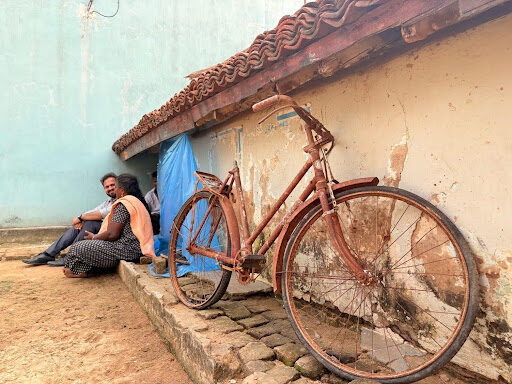
Dr. Saravanan Thangarajan listening to caregivers during fieldwork in Tamil Nadu. Aid contraction and system stress often become visible first inside households.
From the outside, the program may still appear to exist.
Inside the system, the burden has moved.
That is what aid contraction often does. It does not only close offices, end projects, or reduce budgets. It pushes risk downward onto the people and local systems least able to absorb it.
The cost does not vanish. What disappears from a donor budget can reappear as unpaid overtime in a clinic, a larger caseload for a community worker, an operating gap for a local organization, a family’s lost wages, or a caregiver’s exhaustion.
Boston is not outside this story. Its universities, hospitals, nonprofits, research teams, students, and advocates are tied to the same global systems now being asked to do more with less. When funding contracts abroad, the effects are felt not only in ministries and multilateral budgets, but also in local partners, field teams, research collaborations, and community programs that many in this network support.
The numbers are stark. The World Health Organization has warned that external health aid is projected to fall by 30% to 40% in 2025 compared with 2023, with serious consequences for health services in low- and middle-income countries. WHO has also reported disruptions to essential services including maternal care, vaccination, emergency preparedness, and disease surveillance.
A 2026 analysis in The Lancet Global Health estimated that under a moderate defunding scenario, aid contraction could lead to 9.4 million additional deaths by 2030. Under a severe scenario, the estimate rises to 22.6 million.
But numbers alone cannot show where the shock lands.
It lands on the nurse asked to maintain services with fewer supplies. It lands on the program officer trying to explain delays they did not create. It lands on local organizations asked to keep reporting, serving, and adapting while their own operating base weakens. It lands on households, where unpaid caregivers quietly absorb what formal systems can no longer provide.
During large-scale public health operations in Tamil Nadu, I saw this pattern closely. When staffing, transport, referral, or follow-up systems weaken, system stress becomes household stress. The work does not disappear. It moves into longer waits, repeated travel, missed wages, informal caregiving, and quiet exhaustion inside families.
From a distance, this can look like resilience.
But what gets praised as resilience is often unpaid exhaustion transferred into the home.
That distinction matters. A system can remain open and still be failing the people holding it together.
The lesson is simple: continuity is not the same as success. A program can stay active and still shift its hidden costs onto frontline workers, local partners, and families. The harder question is not only whether the service survived. The harder question is who paid for its survival.
A better development model would measure burden, not only outputs. It would track transport costs, lost wages, unpaid caregiving time, mental strain, delayed referrals, and the gaps local partners are forced to cover. It would protect frontline workers and local partners before calling a system stable.
For Boston’s international development community, one question should sit at the center of this moment:
When support contracts, where does the burden go?
Aid cuts are often discussed as budget events.
They are also household events.
If we are serious about equity, we cannot treat clinics, local organizations, community workers, and families as the silent reserve capacity of the global development system.
THE SYSTEM MAY LOOK INTACT.
BUT IF IT IS BEING HELD TOGETHER BY UNPAID EXHAUSTION, IT IS NOT HOLDING.
About the Author
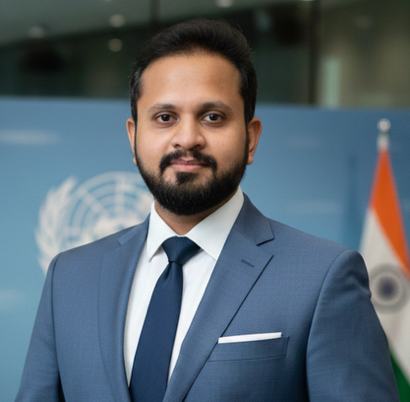
Dr. Saravanan Thangarajan
Dr. Saravanan Thangarajan is a Harvard-trained global health delivery specialist working at the intersection of climate-resilient health systems, caregiver mental health, disability inclusion, and public systems implementation. He has led large-scale public health operations in India and contributes to WHO-linked advisory work on global health systems and vulnerable populations. He now works across global health research, policy, and systems innovation in Greater Boston, with a focus on how health systems can protect frontline workers, families, and communities under strain.